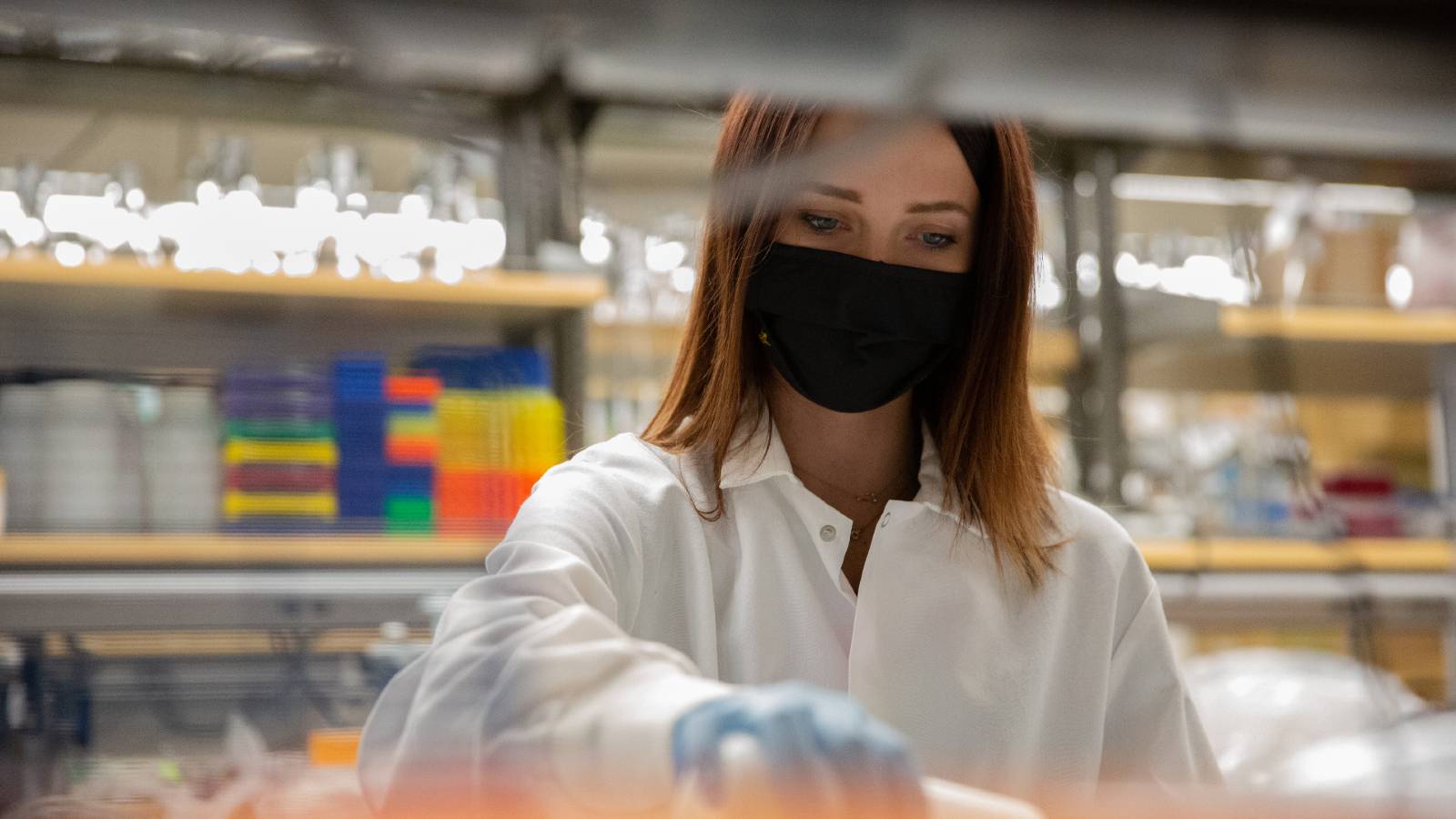
Jumpstart your career in health care innovation
Start your biomedical engineering journey and help build a better future for human health.
Program spotlight
Biomedical engineering, MS
What if the skills you gain today could help create faster diagnoses, smarter medical devices or more personalized treatments tomorrow?
ASU’s Master of Science in biomedical engineering program combines flexible academic pathways with hands-on learning and faculty-guided research. You can explore emerging areas of the field — such as biomedical imaging, biomaterials and neural engineering — while preparing to lead innovation in research labs, health care organizations and technology companies.
Want to view all of our programs?
Our graduate degree programs prepare students to tackle health care challenges at the intersection of health and engineering. Our graduate degrees include master’s degrees, doctoral degrees and an Accelerated Master’s.
Have program questions?
Attend one of our free program info sessions and speak directly with program experts.
Outcomes that matter
Discovering new fundamental principles regarding living systems
Biomedical engineers work at the intersection of technology, biology and medicine, addressing challenges that improve human health and drive scientific breakthroughs. Our biomedical engineering programs emphasize device innovation and provide a rigorous, forward-looking education that integrates engineering design, computational modeling, physiology and clinical problem-solving. Students gain hands-on experience through design projects, immersive laboratories and participation in advanced research shaping medical innovation — from AI-driven diagnostics and wearable sensors to gene-editing tools, neural interfaces and regenerative therapies.
Shape your career path — and the future of health
Our graduates are well prepared for high-impact careers in the growing medical device and biotechnology industries, contributing to technologies such as surgical robotics, prosthetics, implantable devices, imaging platforms and digital health tools. Others pursue paths in pharmaceuticals, diagnostics, clinical engineering, regulatory affairs, biomedical data science or advanced graduate research in areas like precision medicine, synthetic biology, computational neuroscience and tissue engineering.
Our programs also prepare students for advanced clinical training, including medical school and physician assistant programs. With strong technical expertise and problem-solving skills, our graduates are positioned to become innovators and leaders in the global biomedical technology landscape.
Career outcomes |
Median annual salary |
|---|---|
| Biomedical engineer | $106,950 |
| Biostatistician | $103,300 |
| Compliance manager | $136,550 |
| Health and safety engineer | $109,660 |
| Human factors engineer | $101,140 |
| Microsystem engineer | $117,750 |
| Regulatory affairs manager | $136,550 |
| Technical sales engineer | $121,520 |
| Validation engineer | $101,140 |
Data obtained from the Occupational Information Network (O*NET)
under sponsorship of the U.S. Department of Labor/Employment and
Training Administration (USDOL/ETA).
Companies hiring
|
|---|
| Abbott Laboratories |
| Boston Scientific |
| Edwards Lifesciences |
| GE Healthcare |
| Integra LifeSciences |
| Johnson & Johnson |
| Medtronic Siemens |
| Healthineers |
| Stryker Corporation |
| Thermo Fisher Scientific |
| W.L. Gore & Associates |
Make connections with impact
Research opportunities
The School of Biological and Health Systems Engineering at Arizona State University is closely connected to the biomedical industry and collaborates with leading clinical institutions, including Mayo Clinic in Arizona and HonorHealth.
Our students are highly sought after for internships and careers with biomedical companies such as W. L. Gore & Associates, Medtronic and BD. Students gain hands-on experience in industry, clinical, and campus research settings aligned with their interests. Research in our laboratories is highly active, and students at all levels are encouraged to participate, build professional skills and contribute to innovations that improve health outcomes and patient care.
 Industry partnerships
At the School of Biological and Health Systems Engineering, clinical partnerships tie our research endeavors to community needs and solutions. We work full-time on innovations to address the challenges facing society to improve the human condition.
Undergraduate information session
New webinar dates added!
Want to learn how the School of Biological and Health Systems Engineering’s undergraduate program can benefit you? Our undergraduate students explore biomedical engineering through hands-on learning, research and multidisciplinary collaboration. Our program equips students with the skills to develop innovative medical technologies, solve complex health challenges and prepare for careers in industry, research or advanced medical studies. Join our webinar to see if our program is the right fit for you!

Graduate information session
Want to learn more about our grad programs?
Latest news
Pitch Fest student research contest
Question: What year are you in school? Answer: I'm a second/final year Master's student in Biomedical Engineering on the thesis track, working under the guidance of Dr. Andrew Yang, Dr. Bradley Greger, and Dr. Christopher Buneo. Q: Can you tell us what it felt like when you heard your name announced as the winner? A: It felt gratifying as all our brainstorming and hard work finally paid off. Q: What was the driving force behind your decision to participate in the College of Health Solution's...
ASU-Mayo grant award for modeling and screening therapeutics for neurological diseases
Brain research and single-cell analysis are used to develop heart and nerve cells.
Welcome, new faculty!
Welcome our new biomedical engineering faculty for 2024-2025, bringing fresh expertise and innovative ideas to our academic community!
Faculty news

Barbara Smith has earned the PECASE for neurodegenerative diagnostics
Associate Professor Barbara Smith is developing brain imaging technologies and identifying disease markers for neurodegenerative diseases. Her efforts have distinguished her as a powerhouse in neurological disease diagnostics.
In 2025, Smith’s efforts in and out of the lab were honored with the Presidential Early Career Award for Scientists and Engineers, or PECASE, the highest honor bestowed by the United States government on outstanding early-career researchers who demonstrate exceptional leadership early in their research careers. The award honors Smith’s impact in science and her dedication to mentorship, education and shaping the next generation of engineers. Her efforts to identify essential cells and distinguish features for disease diagnostics are paving the way for a greater foundational understanding of how neurodegenerative diseases function.

Kuei-Chun “Mark” Wang has earned an NSF CAREER Award to battle neurological disorders
Delivering medication precisely where the body needs it is one of nanomedicine’s biggest challenges. Assistant Professor Kuei-Chun (Mark) Wang has been working to overcome that obstacle by designing nanosized drug carriers capable of moving through the body and accumulating in diseased tissues. This work has earned him a prestigious National Science Foundation Faculty Early Career Development Program (CAREER) Award.
The CAREER Award supports early-career faculty who demonstrate their potential to serve as academic role models in research and education and to lead advances in the mission of their department or organization.
Explore our biomedical engineering degree programs
At ASU, we offer a rigorous program in biomedical engineering with opportunities for students to be involved in research, entrepreneurship, healthcare delivery, biomedical device design and global health.