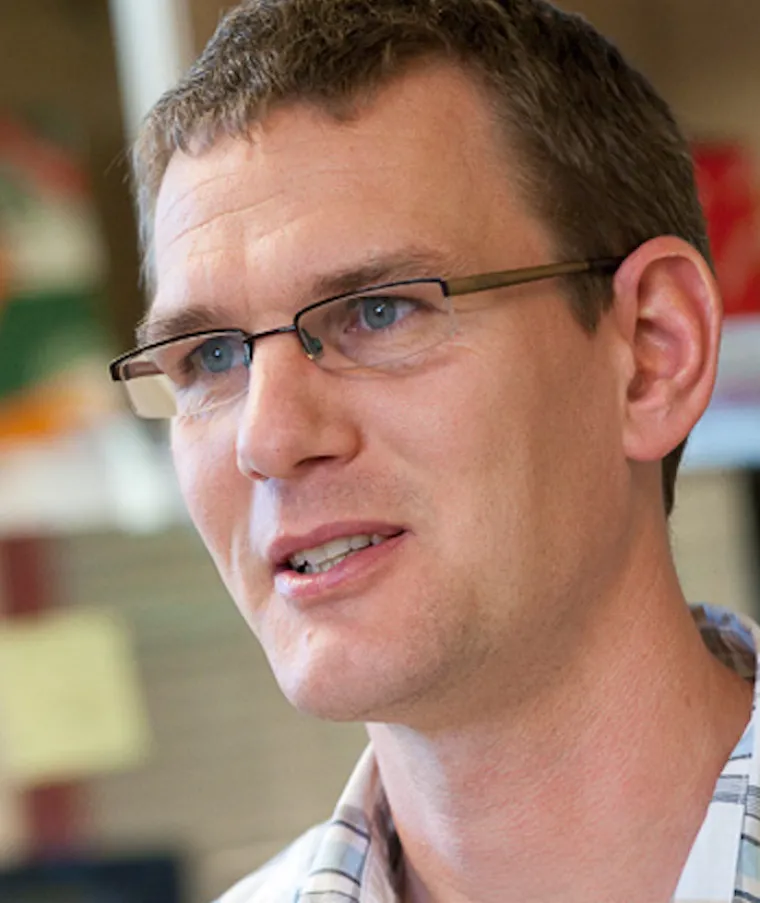
Ingmar Riedel-Kruse, PhD
Professor, Department of Molecular and Cellular Biology, University of Arizona
Date: Friday, April 24
Time: 9–9:50 a.m.
Location: SCOB 228
Faculty host: Xiaojun Tian
Abstract
Multicellular systems, from bacterial biofilms to human organs, form spatial patterns and interfaces to achieve complex cooperative functionalities. Our understanding and ability to rationally engineer and control such active matter is still limited. To this end, my lab develops synthetic and optogenetic approaches that enable the versatile control of cell-cell and cell-surface adhesion for multicellular bacterial patterning. I will discuss the molecular engineering and biophysical characterization of such synthetic adhesins. I will then demonstrate their utility as a build-to-understand approach for basic scientific questions such as studying the physics and combinatorial self-assembly of active colloids, the programming of tissue-level interface and tiling patterns that mimic developmental programs, and the evolutionary origins of multicellular life. I will also demonstrate practical applications for health and sustainability, such as tunable biomaterials and microbial consortia for small molecule biosynthesis, e.g., converting greenhouse gases to value chemicals.
Biosketch
Ingmar Riedel-Kruse is a professor of molecular and cell biology at the University of Arizona. He earned his Doctor of Philosophy in biophysics from the Max Planck Institute of Molecular Cell Biology and Genetics in Dresden, Germany and served as a postdoctoral researcher at the California Institute of Technology in Pasadena, USA. Prior to his position at the University of Arizona, Riedel-Kruse worked as an assistant professor of bioengineering at Stanford University. His research interests include understanding and engineering multicellular systems and behaviors using approaches from synthetic biology, biophysics, microbiology, mathematics and interaction design.